Tuesday, May 17, 2022

The Slow Train from Bangkok to Hat Yai

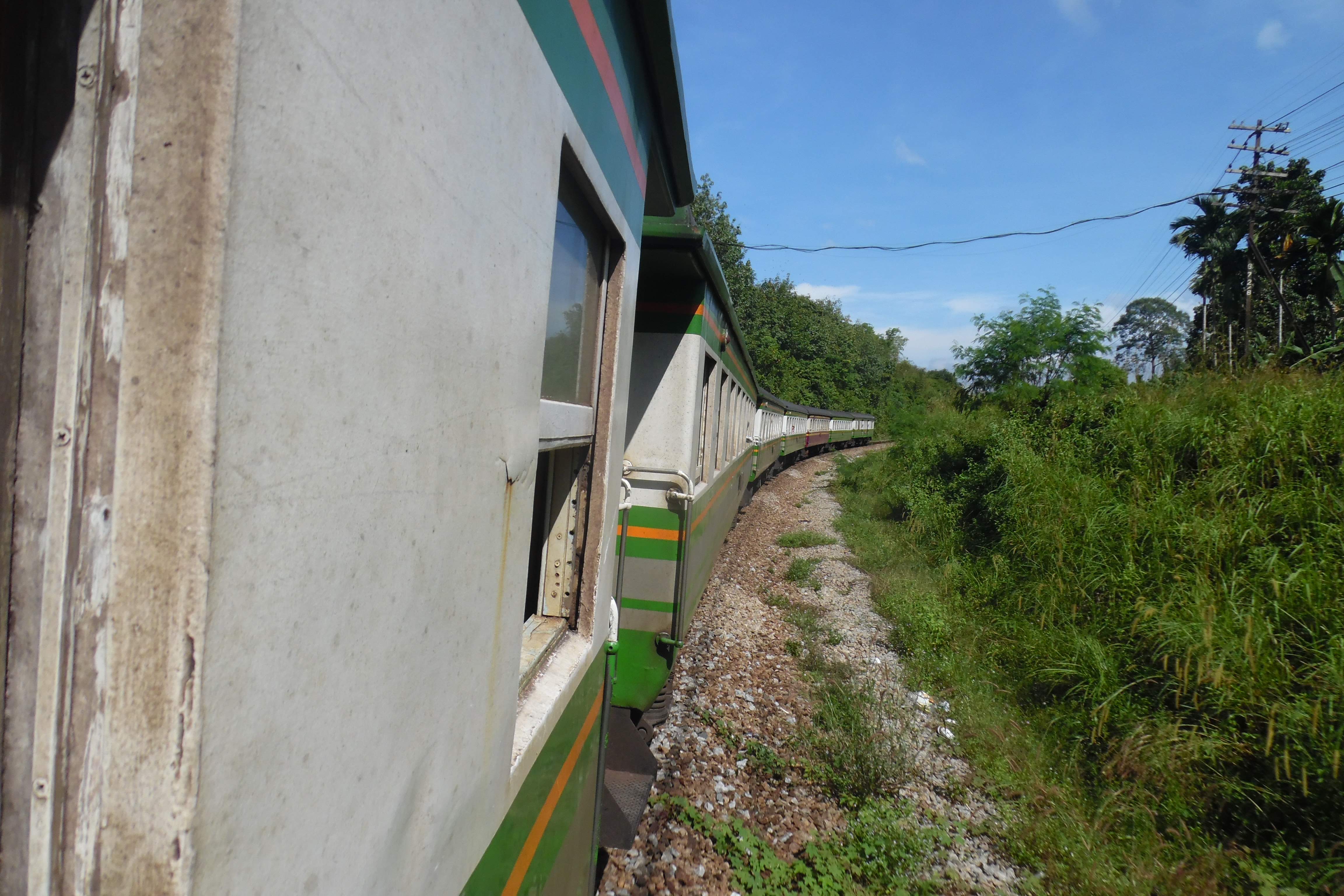
Thailand is working hard on a new railway system. Double track and electrified. No doubt train travel will become more efficient. But the older slower trains had some charm too...
This is a trip we made in 2019.

Stage one: Bangkok to Samut Songkhram (Mae Khlong)

Going south there is an alternative to the main line. There’s a stand-alone line from a Bangkok suburb to the almost-coastal town Samut Songkhram. It’s actually fewer kilometers, except it doesn’t connect to the mainline, making it a cumbersome enterprise.

The journey started with the modern Skytrain from Siam Square. We crossed the Chao Phraya river and got off at Wong Wian Yai. It’s a bit of a puzzle to find the right exit and the right flyovers.

Hidden behind a market is a small train station, also named Wong Wian Yai. It’s the starting point of the slow train to the southwest, single track. There are only a couple of connections per day  for this trip. We rode along small houses and the backs of buildings, past banana trees and market stalls. Slowly the urban development became less dense. After an hour, in which we covered 30 km, the terminal station was in a large fish market in Maha Chai /  Samut Sakhon.

From there it was a short walk to the river, which we crossed by ferry. There was just enough time for a quick lunch and a coffee at a halfway café that obviously catered to travellers making exactly this trip. It was much more modern and stylish than its surroundings


Then another ten minutes walk to the next train station, Ban Laem, where a similar train ride took us to the next river. This stretch was more rural, with large fish ponds and salt basins. Here too, the line ends in a market. When a train comes in, the goods have to be moved from the tracks and the marquises folded back. This has become a true attraction in recent years, and is visited by thousands of tourists as a day trip from Bangkok. So our train was welcomed by a huge crowd that was photographing and waving at us.


Unlike most visitors, we stayed the night in Samut Songkhram. That gave us the opportunity to see the evening train arrive. But now the market was closed and there was hardly anybody around.

The next morning we watched the scene from the other side. Already busloads of tourists had arrived from Bangkok to watch the spectacle. Some stall owners had put their crates of goods on a moving rack, which slid over small rails to make just enough space for the train. Others had stacked their vegetables so low that the train ran overhead the cabbage and mangoes. What struck us was how little space there was between the market stalls and the train. Really just 2 to 3 cm clearance. And a train is very big when it passes a few centimeters from you ...

Stage two: From Hua Hin to Chumphon

Hua Hin

It should be possible to take a bus from Samut Songkhram to nearby Ratchburi or to Petchaburi and catch a train there. But we happened to end up in a minivan to Hua Hin. A combination of a typical small Thai town and a seaside resort. Lots of Scandinavian families there.

Hua Hin railway station is a beautiful wooden building, almost a century old. The famous royal waiting room isn’t that old. It was all very pretty, with fancy details.


We bought a train ticket for the next day.The station café was closed, but opposite was Patty’s Corner, a nice place with excellent coffee.

To Chumphon

Our train should leave at eleven thirty. It was delayed for half an hour. Apart from our express train, several slow trains were due to leave both north and south.

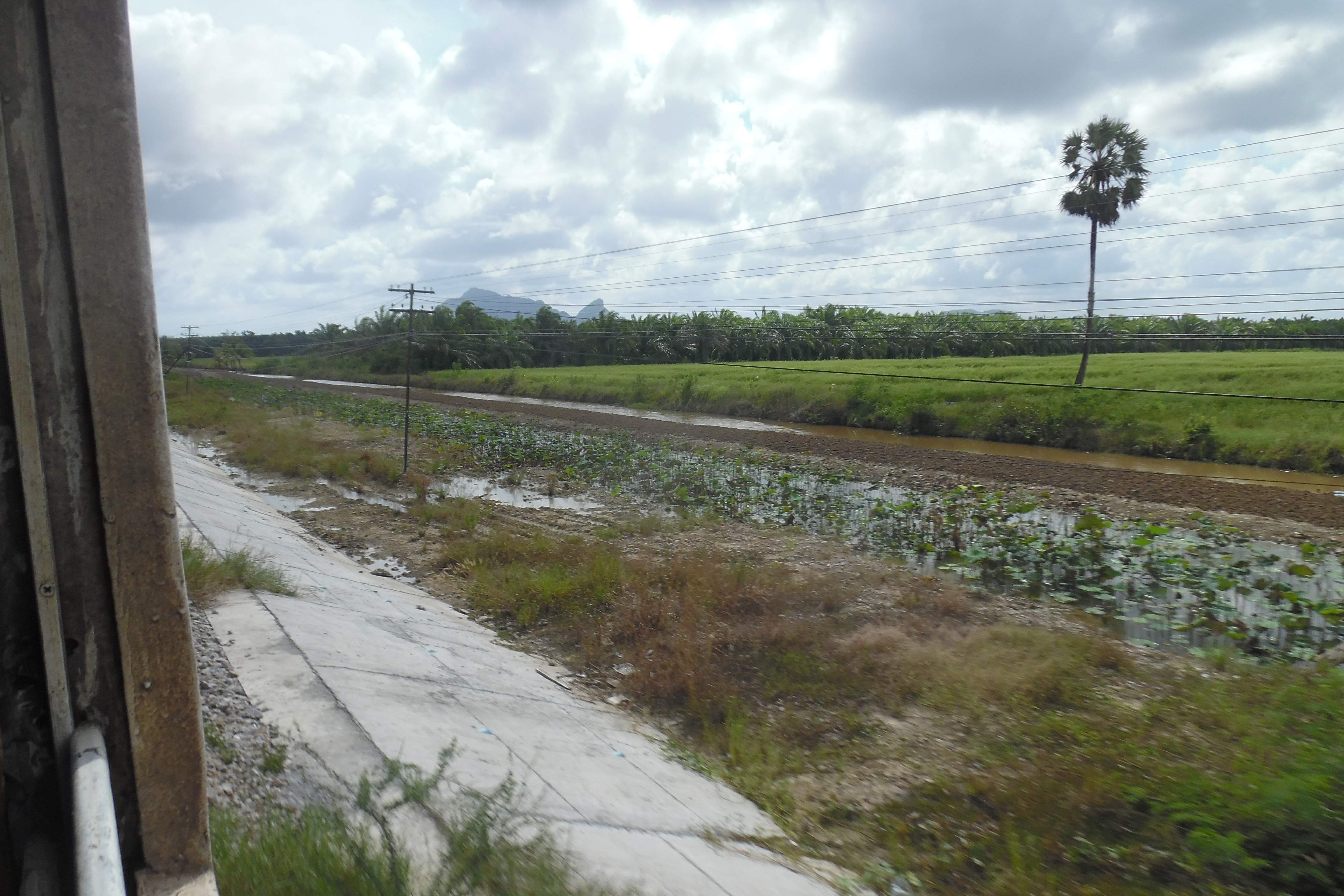
We had the fast diesel train, reaching up to 120 km/h. It had only three carriages, air-conditioning, and reserved seats. It was filled half with tourists and half with Thai. We saw a lot of construction work along the way: all for the modern fast track being built. The further south we came, the more green, palm trees and rubber trees we saw.

A lot of the tourists got off at Chumphon. You can take a ferry here to the popular islands Koh Samui and Koh Tau. We stayed on the mainland, and had a couple of days at the almost deserted Thung Wua Laen beach.


#singletrack

Often there were just one or two trains a day that were useful to us (there are also many night trains, which we disregard). These are old tracks and diesel trains, with antique signalling systems that work with hoops, tokens and flags.

To prevent two trains running into each other on a single track, each track section (block) has one token (a metal disc) that a driver must have to be able to drive on that section. At stations where opposite trains pass each other, the token is given to a station employee. To make the transfer easier from a moving train, the token is clamped in a large hoop. The station employee brings the hoop with token to the other train. Sometimes the employee pulls a long sprint for that, once we saw him driving down the platform on a moped!


If the train enters a new section at a station where it does not have a scheduled stop, the co-driver may just throw the token of the past section onto the platform, and pick up the next token from a post it is hanging on – without stopping!


Stage three: from Chumphon to Surat Thani (Phun Phin)

When we bought our tickets for Surat Thani, they were a lot cheaper than for the previous stage. Even though it was the exact same train. Was it because we bought them on the day of travel in stead of in advance?

Next to the station is Aeki’s Bar, a great place to have lunch before the train departs. Lunch time was quiet. It seemed to have more tourists coming from the islands, waiting for the night train to Bangkok.

So we had the same train, with the same delay, but today it was a much older one. A lot of tourists got off again, but we were the only ones getting on.

At a quarter past five we arrived at Surat Thani station, which is way out of town in the suburb of Phun Phin. The transfer point between the Gulf and the Andaman, and between Koh Samui and Bangkok. We were immediately approached by touts who wanted to sell transport. But we quickly slipped out of the back of the station via the footbridge. Via a small market we arrived at our hotel. The room was very basic but absolutely ok. With train view if you leaned out the window.

Close to the station were some restaurants that catered to tourists waiting for the night train to Bangkok. In one of them we had a great pad thai. The waitress and the cook were in a good mood, so it was a happy bunch. Everybody was very friendly in Phun Phin, which was a lot livelier than I had imagined.

For most people this is a transfer point. But you can actually use Phun Phin as a base for a day trip to Ratchaprapha Dam a.k.a. Khao Sok National Park.


Stage four: from Surat Thani (Phun Phin) to Phathallung

We had tried to book our ticket the night before, but the reservation system was down. When we returned to the station in the morning, the express train was full. So, we took the “ordinary”, the slow train. A very local  affair. The interior, the benches, the walls, the floor, everything was made of wood. Open the windows and the warm air blew through your hair. The noise from the engine and wheels was deafening. Earplugs highly recommended if you don’t want to damage your hearing. We reached almost 90 km / h.


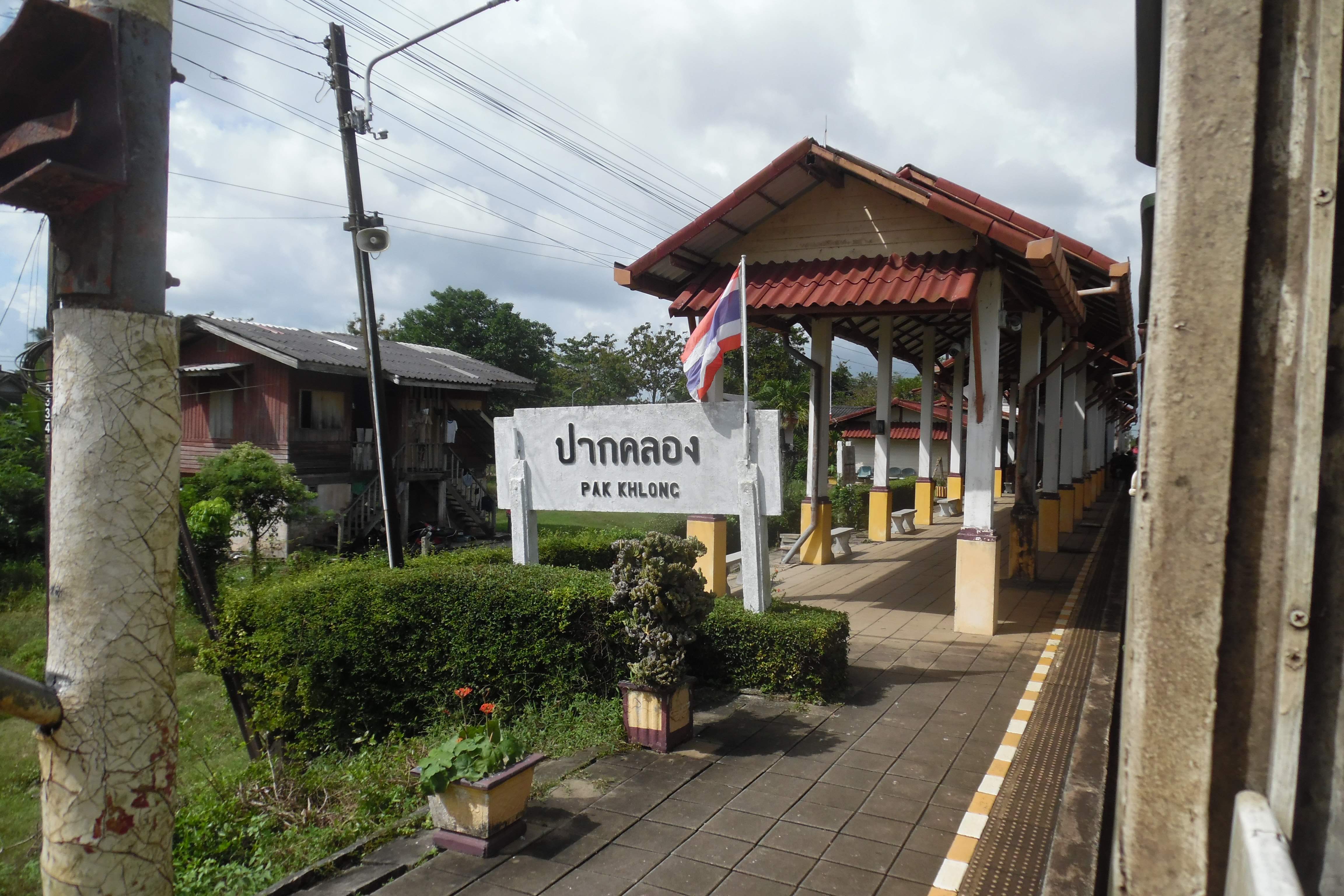
The landscape was green, humid, hilly, rural. We stopped at dozens of small stations. Some were hardly more than a platform, others had cozy looking station buildings and a well tended garden. We could closely watch the procedure of the passing of the hoop. At one station the opposite train was rather long. The station guy drove his moped to the end of the platform to collect the hoop!

It was a lovely ride, but after 4½ hours, wooden benches are very hard indeed and the afternoon heat sort of cooked us.

Phathallung

Phathallung is another dusty provincial town, with a lot of charm once you see it. To reach the foot of Khao Ok Thalu, the mountain overlooking the town, you can go via the shunting yard. Luckily there were some floorboards over the cables that served the signals and switches. One more ditch to cross and we were out of town.

About 8 km to the east of Phathallung is Thale Sap, the largest lake of Thailand, connected to Lake Songkhla.

30 km to the north is the smaller Thale Noi. Still pretty large and with a stunning bird reserve. If Thale Noi is your destination, you may consider getting of the train earlier, at Pak Khlong station. No guarantee though further transport will be awaiting you.


Stage five: from Phatthalung to Hat Yai

We picked up sandwiches and coffee at the Seven – their coffee is simply the best. We drank it at the station. Slowly it became busier, especially with elderly ladies who carried baskets of food to sell on the train. They targeted the express- and rapid trains – our ordinary didn’t have many passengers.


Our train was on time. It was another nice ride through a lot of greenery. Rice fields, rubber plantations, cows, birds. It was quiet on the train. Until we arrived in Hat Yai and so many students got on so fast that we could barely get out.

Hat Yai is the centre of the deep south. From here you can take trains further south to Yala, Sungai Kolok or Padang Besar. The latter is the place for crossing the Malaysian border and catching a train to Kuala Lumpur or Penang (as we did the year after in the opposite direction)

We could have taken the direct night train. But this was much more fun!
Train travel is the way to go in Thailand. It is easy, easygoing, comfortable and gives you a beautiful view of the country and the countryside.


Thailand, January 2019 – Amsterdam, May 2022


More

The SlowTrain from Trang to Bangkok 

More blogs on Thai trains

More blogs on Thai travel and destinations


Sunday, May 1, 2022

Riots in Thailand, May 1992

There was this huge departure board at the Bangkok airport. It was about 3x4 meters in size. Each departing flight was on a line consisting of a number of positions, each of which had 36 rotating flaps: all letters and numbers. When the top flight had left, all positions rattled until the second flight was displayed. Then it rattled and the third flight took the second position. And that happened about 20 times. By the time it was done, sometimes the top flight would already take off and everything would start over.

We spent many hours under that board. Political tensions were running high. The airport was cut off from the city due to heavy riots. The kerosene was almost finished. Could we still get away?

Front page of the Bangkok Post

30 years ago I made my very first trip to Southeast Asia, to Thailand. The global plan was to fly north via Bangkok, descend slowly overland to the south, end up on a bounty island, and then return via Bangkok.

Chiang Mai

With a million inhabitants, Chiang Mai was the second largest city in the country and the capital of the north. The 'old city' ( muang ) lay within a square of about 1x1 kilometer, surrounded by the remains of city walls and a moat.

The larger shopping streets ran between the old center and the river. There was the noise of traffic everywhere: an endless stream of mopeds, tuk-tuks (a kind of covered tricycle mopeds with two-person rear seats, that served as taxis) and songtheaws (Japanese pickup trucks, with two benches in the back that served as busses)

Everywhere in the quiet dusty old center and also around it were dozens of temples ( Wats ). Usually located behind walls, so instantly quieter than the street. They were often somewhat neglected, had bell-shaped stupas, gabled roofs and mosaic decorations, sometimes gilded or with remnants thereof. Sometimes deserted and sometimes still in use, the monks shuffled around there, their heads shaven and wrapped in orange robes. You also regularly saw them in the street, or in the cabin of a songtheaw .

Towards the river was the Night Bazaar, a large market with 1001 stalls with items from the wider area. Clothes, souvenirs, gadgets, rarities, games: everything seemed to be for sale here. 

And the Thai everywhere: smiling back when you smiled at them, leaving you alone when you left them alone, always pleasant and with an inner peace that sometimes radiated visibly.

After a few days it was a national holiday. It had been 46 years since King Bhumibhol was crowned. The king was revered as a semi-god by the Thai, his actions and thoughts (represented in books and music) were widely reported, and criticism would be unimaginable. But it were turbulent times in his kingdom. Every day there were demonstrations against the semi-military government in the square near the eastern city gate (Tha Phae), and there was also unrest in Bangkok, as we read in the English-language newspapers.

For dinner, our favorite destination AUM , a small vegetarian restaurant, soon became dominated by a photo of Sai Baba. Downstairs three small formica tables, upstairs cushions for those who wanted to eat seated on the floor (shoes off). All very simple, but of great quality and very friendly people.

We also regularly visited Daret, a large restaurant with wooden benches and red and white checkered table cloths outdoors under the trees. It was the meeting place for the itinerant backpackers, and also had good food.

On a Saturday night we went to look at some different places of entertainment. You can order a beer (Singha) at the bar or on the semi-open terrace. There were some young Thai ladies at the bar. They would come and have a chat with you and refill your glass of beer. Then they would ask for a drink that was lemonade but cost the same as expensive whiskey. The audience mainly consisted of slightly older men and/or they had already a drinks too many and/or they were quite fat and unattractive. It was no surprise that the ladies preferred to come and have a chat with M and me.

Conversations were in broken English, in the end we also started using a simplified vocabulary and sentence structure. What made it difficult was that the Thais seemed unable to put a sense of time in their language: it was never clear whether something you were talking about was in the future or in the past. Perhaps that was characteristic of the attitude to life: the present is reality. Looking back and forward was not done as much as in the west.

The Golden Triangle

Monday we got up at six o'clock, along with the sun, for a day trip to the northernmost tip of Thailand. This region used to be notorious as the world center of opium cultivation. Now it was mainly the three-country point that attracted tourists. A row of stalls selling food (including our lunch) and souvenirs had formed along the way, and children in traditional costumes had themselves photographed for ten baht .

In the background, majestically wide and imposing, lay the Mekong, one of the mightiest rivers in the world. Brown muddy flowing. On the other side the banks of Laos, and a little further on behind a branch was Myanmar (Burma). A few dozen meters below us small narrow boats were moored. Every now and then one would come by with a deafening roar from the engine - they could go pretty fast.

Over a dirt road that our van could barely navigate, we went to the next stop, the border town of Mae Sai. The border here was formed by a small, narrow river. You could cross the bridge and even take a few steps past the barriers, so that we had actually set foot on Burmese territory, but you couldn't really get in here as a foreigner. It was possible for the border residents to cross on foot, which resulted in a steady flow in both directions. In Mae Sai there were also many stalls and shops, and it was very busy.

On the way back we stopped late in the afternoon in two 'hilltribe villages'These were ethnically different people, and the already limited economic growth of the rest of Thailand seemed to have passed them by (except for those who had discovered tourism). It looked very shabby: unpaved dirt roads, wooden huts, some free-range chickens, children who came barefoot and in a worn dress or t-shirt asking for ten baht .

Sukhothai

We liked Chiang Mai so much, with its relaxed atmosphere and the many excursion options, that we lingered longer than intended. But today we finally moved on as by our original plan: a stage to the south, 5 hours by bus to Sukhothai.

Sukhothai was much poorer, less touristy and less exposed to western influences than Chiang Mai. Most people who visited the ruins of this ancient Thai capital did so from nearby Phitsunalok. There was a still, scorching heat.

The next morning we hired a tuk-tuk with a driver, who could drive us around for a couple of hours. That took us through a very beautiful, vast area full of ruins and sometimes partially restored remains of temples, palaces, lily ponds, statues of Buddhas and elephants, ... Too much to take in. An entire city had once stood here in all its glory. And now only the remains between the open meadows, a few people looking around, otherwise it was absolutely quiet and deserted. It was also pretty hot between the stone remains.

Back to 'new' Sukhothai. Our hotel had no room for that night. Moving to another? Well, actually we had seen everything here. Maybe move on to the next destination south? ... Or-eh...? Why not back to Chiang Mai? We looked at each other again, and it was deceded. On to the bus station.

Bangkok

We had lingered in the north of Thailand for so long that we finally took the plane to Bangkok. At that time, Don Muang was the only airport in Bangkok, the international and domestic terminals were a kilometer apart. In the arrivals hall it seemed like you could only take expensive limousines into the city. Eventually we found out that there was also a city bus that stopped along the eight-lane highway that passed in front of the terminal. In the increasingly busy traffic, the bus didn't make much progress, but after more than an hour we arrived at Siam Square, the neighborhood we had chosen to look for a hotel. Not the cheapest area,  between the center and the business and entertainment districts.

There was a wide range of hotels in the alley. The ones up front were a bit overpriced, the ones in the middle too shabby, but the last one in the back, Wendy's, was fine: modern and clean and cool.

Siam Square  would always remain my favorite area of ​​Bangkok. With the arrival of the Skytrain it has only become more attractive as a base.

We took a look at MBK, the large department store on Siam Square. (Later, another row of much more luxurious department stores would appear along Siam Square.)

The pedestrian flyovers also led into the complex, forcing you not only to walk through it, but were also concealed in such a way that you almost certainly had to get lost. It consisted of some large, expensive shops, and long corridors of small shops with everything you could imagine. We went to eat at the foodmarket on the top floor of the department store. It consisted of a lot of small food stalls, including a few vegetarian ones with delicious food. Strange that something you would expect outside, is upstairs in a large building.

Bangkok was a stuffy, oppressive, hot, dirty, noisy, big city. About ten million inhabitants. Wide streets with six lanes of rushing or jammed traffic. Crossing was sometimes impossible, and then you had to use one of the many pedestrian bridges. A system of toll/motorways was constructed on high concrete pillers.

In the evening we walked to Patpong, the entertainment center. It was a lot less innocent than in Chiang Mai. Much more noise, advertising and people trying to lure you in. Here's that dubious phenomenon of go-go dancers: girls in bathing suits dancing on the bar in disco light.

To the centre. First a temple with a solid gold Buddha statue. Then a long walk through Chinatown, with very narrow streets completely jammed with market stalls with all kinds of vegetables and fish. We didn't see a restaurant that was open, and it seemed impossible to get something vegetarian at the stalls on the street. Well, finally a bite of rice.

At the end of what seemed to be a dead end street, you could go through a kind of gate and you came to the stop of the riverboat, which sailed the Chao Praya like a kind of bus. We zigzagged from one bank to the other, with magnificent views of river life, boats and buildings along the bank.

From where we got off the boat we walked through the neighborhood with the low-budget hotels. We had a thick banana pancake somewhere and tasted the special atmosphere of that neighborhood. Khao San Road was not for us.

The next day again we took a bus (Skytrain/BTS and metro did not exist yet) into the center. We walked past the Democracy Monument along a field where again all kinds of demonstrations were held. Towards the royal palace, but we were not allowed in because we were wearing shorts. Smartly, some traders had anticipated this because you could buy long trousers opposite. But we only saw the white outer walls with battlements.

To Wat Po, a large monastery complex with all kinds of beautiful, partly dilapidated and partly restored stupas . And with the gigantic reclining Buddha: fifty meters long, and gilded. There was also a school in traditional Thai massage on the monastery grounds, where you could both take lessons and undergo treatment. In a hall about thirty mattresses were placed next to each other. You had to wash your feet and put on a loose-fitting cotton shirt and pants. In addition to their hands, they also used legs and feet to squeeze you into all kinds of poses. In addition to your muscles, your guts and bloodstreams were also manipulated. Blood supply from your arms and legs  was pinched off for a minute...

If you got to know it a little better, through the hectic, busy, sweaty Bangkok you saw  a city with its own atmosphere, charm and even tranquility.

We followed the developments in the English-language newspapers. The tension seemed to be mounting. Large demonstrations had been announced by the opposition for the weekend, which had been banned by the government. The tone grew grim. We thought it was time to leave this city.

Phuket

By plane to Phuket. A large island in the south of Thailand, on the Indian (west) coast.

Phuket town was a true provincial town, with shops and a lot of traffic. But for tourists there wasn't much. They were all on the various beaches the island had.

On Sunday we also decided to move to the coast. Behind the market the buses left for all corners of the island. Ours was a slightly larger sized truck, with four long benches in the back that could seat about fifty people. With that we drove to Patong Beach, one of the older 'resorts'. In the meantime, new beaches were developed, each targeting their own audience (more chic, more sporty, etc.).

Patong lay in a bay. The main road ran parallel to the beach. Left and right, the forested foothills of the hills ran into the sea. At the end the beach was pierced by a small river, and you could just wade past it. Or couldn't we, and did we have to cross the old uphill bridge? On the beach some palm trees provided some shade, which was welcome under the scorching sun. That very sun had put us on the wrong foot orientation-wise: we lost our direction for a while, until we realized that we were below the Tropic of Cancer, and the sun was now in the north!

In the meantime, we followed the news closely. The demonstration at the Democracy Monument in Bangkok had gotten completely out of hand. Hundreds were killed in shootings, and the chaos was complete. When we read on Tuesday that the kerosene supply at Bangkok airport was only sufficient for two more days, we decided to leave the next day. Calling the KLM office in Bangkok heeded no response (!?).

End

Although the plane to Amsterdam didn't leave until after midnight, we didn't want to risk taking the last flight out of Phuket, so at noon we went to Phuket airport. We just caught the two oçlock flight, so that we were already at the airport of Bangkok at three in the afternoon - while KLM would only leave at half past one in the morning. First we made inquiries at the KLM office. There we heard that for security reasons the employees had already stayed at the airport for a few days, and that in the meantime no traffic was possible between the city and the airport.

The long wait began. Sit down for a while. Then take a walk through the large, overcrowded departure hall. Then sit down again. Then take a trip outside over the highway and railway, where in the oppressive heat there was a small market and some shops next to the train station with wooden roofs. Then sit down again. Then have a snack in the cafeteria. Then sit down again. Then stretch out for a while in a quiet hallway on the cold floor. Then again sit in front of the large departure board, where the new flights appeared clattering. In the night we saw a lot of flight to Europe saw leave - KLM would be the last in line.

Then, at midnight: great excitement! The monitors in the departure hall switched to a live speech given by the king. All the Thais ran from behind their counters to crowd in front of the screen. The king, standing far above the parties here, had finally decided to intervene and summoned the government and opposition leader. According to Thai custom (your head should always be lower than the king's) they knelt at his feet. He ordered them to shake hands and admonished them to reconcile. And with that, the worst of the bloodshed seemed to end at least for now.

from left to right Chamlong Srimuang, General Suchinda Kraprayoon, King Bhumibhol

At that exact moment we had to go through customs and to the gate for our flight back to Amsterdam.

I would go back to Thailand about 15 more times in the next 30 years, and also several times to 6 of the neighboring countries. My favorite region first was the north, then the northeast, and nowadays the south and Bangkok. Read more Thailand blogs here .

In the same 30 years, there have been more riots and mass demonstrations, and several coups by the military.

Friday, November 1, 2019

Nathaniel's Nutmeg - Giles Milton - book review


"Nathaniel's Nutmeg" is a vivid and gripping story about the search for the spice islands and about the struggle to get hold of the spice trade. Spices such as cloves, mace and especially nutmeg were just about the only means to keep food (or to suppress the spoiled taste) and to cure diseases (or to soothe them). Nutmeg was more expensive in Europe than gold, while in the Far East it could be picked up for a dime. If you survived the long and dangerous sea journey.

The highs and lows take place at the end of the 16th, beginning of the 17th century. From an English perspective we read about the distress on the ships and in the outposts and how the Dutch get the upper hand on the Moluccas / Banda islands. Notorious Dutchmen like Jan Pieterszoon Coen play a leading role. The book provides a staggering insight into a period of history of which you may have been vaguely aware, but probably know no details.

Two things stand out. 
(1) Being Dutch, I will be the last to play down how violent, ruthless and unjust the VOC has conquered Indonesia. The writer explicitly says so too. Remarkably, on the other hand he portrays the English as honest, reliable and loved by the local people. If they are ever betrayed, murdered, extradited or exploited by an Englishman, that was the incidental misconduct of an individual. The English people as a whole retain the moral upper hand. It takes little insight to see that the English were no better than the Dutch.

(2) The title and subtitle ("How one man's courage changed the course of history") do little justice to the content of the book. Nathaniel Courthope plays a minor role and his contribution is that he managed to defend a small island (Run, one of the Bandas) for a few years. That should have given the English a piece of the spice trade - but failed. 
Decades later, as part of a peace treaty that mutually consolidated conquered territories, Run island became Dutch and Manhattan became English. And the latter island is indeed of greater importance in today's world. The book omits what Dutch schoolbooks find more important: Surinam (Dutch Guyana) was part of that deal - they don't even mention Run. Of all the factors that led to that exchange and the rise of New York, the steadfastness of Courthope was only a futile one. By making New York so much more important than the Moluccas, the book unmeritly subverts its own importance to understanding history.

More


More book reviews.

The last king of Burma and the last emperor of India (2/2) The Last Mughal - William Dalrymple


William Dalrymple - The Last Mughal

Dalrymple describes the events surrounding the great uprising in India from an original perspective, which differs considerably from British historiography.

Bahadur Shah Zafar was the emperor or mughal of India in name, but all the power was with the British occupiers. After the mutiny in 1857-1858 he was exiled (forever disturbing the balance between Hindus and Muslims in India along the way) to Rangoon in Burma - now Yangon in Myanmar. There he died in 1862. He was buried as quickly as possible by the British in a secret place, not to create a place of pilgrimage for anti-British. His grave was rediscovered in 1991.

The location of his grave had been a secret for a long time. But the book gave some clues as to where it was, so now we wanted to look for it. The first step was to find a hotel in the part of the city where the grave should be. Theatre road now had a Burmese name, but our guess was it must have been near the National Theatre.

The second step was to inquire about the Shah's grave at the hotel reception. Five people pieced the answer together, and they even sketched us a map. It was a half-hour walk. Through the embassy area, with many vacant ministries. The capital was recently moved to a newly built city in the interior. The Russian embassy was an unprecedented fortress with high walls, lots of barbed wire, heavy security and fenced off streets.


When we arrived at the destination, we had to ask for the exact location. Five different people gave four opposite directions. But after fifteen more minutes we had found the right place.

A modest compound with small minarets; some halls ("established in cooperation with the Government of India"); three "graves" that looked like a made-up bed, for the Shah, his wife and his daughter-in-law. A little further on, where his real grave was found in 1990, a basement with another tomb.


There were some visitors who worshiped the deceased as saints (in the religious sense). It was lively and serene at the same time. The whole thing was simple but made quite an impression.

 Yangon, January 2008

The last emperor of India had been exiled to Burma. The last king of Burma had been exiled to India. I had now visited the last place of residence / grave of both. This makes history tangible.

PS Nowadays both places are easy to find on Google Maps and attract quite some foreign visitors.

More

Continue reading about the last king of Burma.
More book reviews.